In detail
AI-Karma in detail
What the home page summarises, set out in full: the use cases, before and after, a complete case, the method, the free tools, guided support, our evidence, who leads the audits and the frequent questions.
01Use cases
Three ordinary uses, three different sets of obligations
Using ChatGPT to draft your customer emails?
No specific AI Act obligation, but the FADP applies as soon as personal data is entered, and your staff need to know what they are allowed to paste into it.
Does an HR tool screen or rank your applications?
Employment is listed in Annex III of the AI Act: full obligations from 2 December 2027, and Art. 21 FADP already governs automated individual decisions today.
Does a chatbot answer your customers on your website?
If it is accessible to EU customers, it must disclose that it is a machine as of 2 August 2026. Our transparency notices, ready to paste in four languages, cover this case, free of charge.
Your exact situation depends on the use case, not the company: classify yours in 5 steps, free of charge.
02The difference
What actually changes
Without AI-Karma
Vague obligations, discovered too late
Your obligations identified and dated, use case by use case
No inventory of what your teams are using
An AI system register, generated and exportable, ready for an auditor
“We should deal with this”, without knowing where to start
A costed action plan, point by point, with the evidence to produce
No reference point before paying for an external audit
A free assessment in 26 questions, and a guided audit from CHF 3’900 (pilot cohort)
A customer, a bank or an insurer asks about your use of AI, and nothing is ready
A printable dossier to attach to your answer: score, answers and evidence, register, action plan, self-declared
03A complete case
What your result looks like
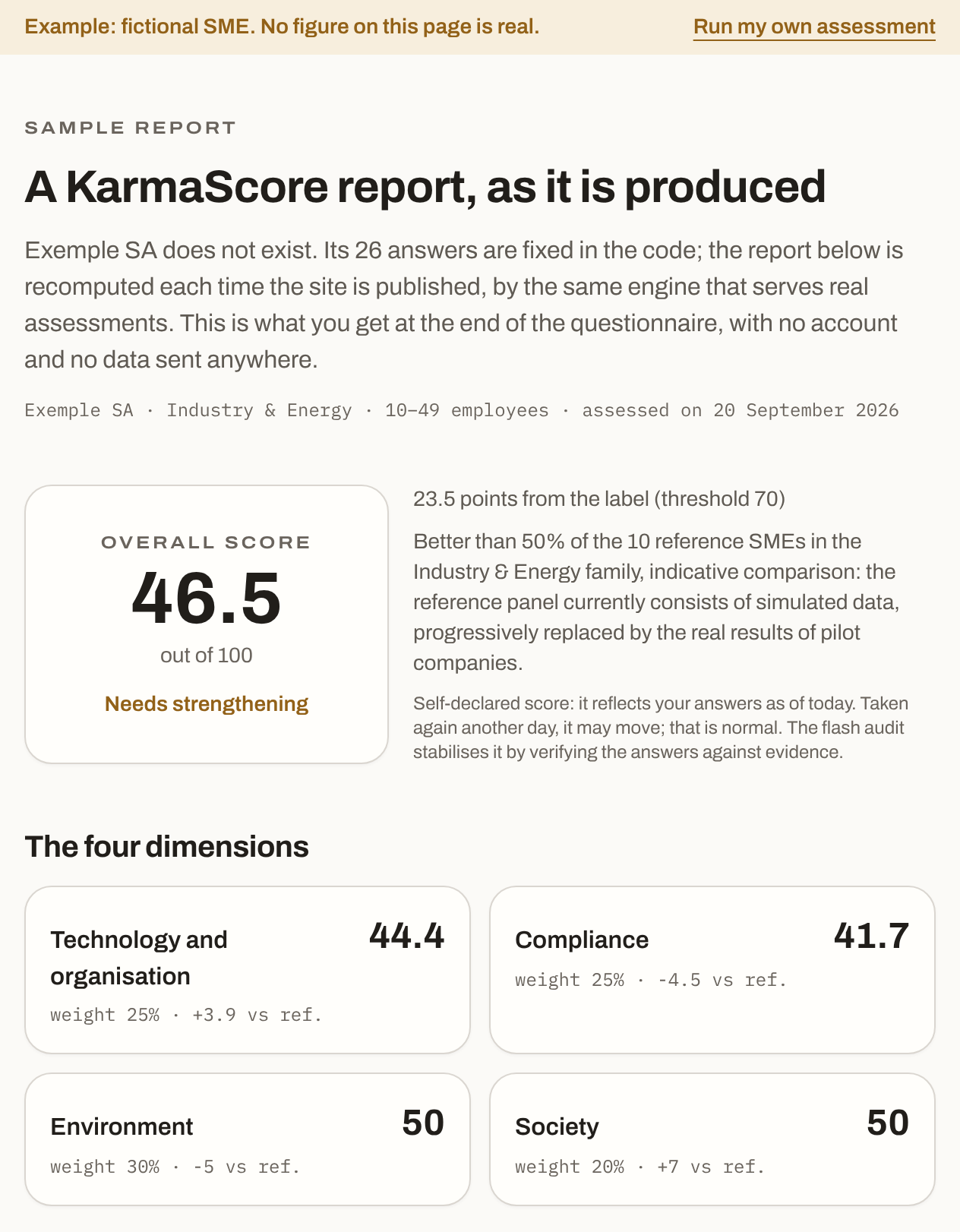
The report of a fictional SME, as the tool displays it: the score, then the top of the action plan, where a legal obligation left at zero comes before everything else.
One case, start to finish · Exemple SA, a fictitious SME
- 01
The situation
An industrial SME with 10 to 49 people. A chatbot answers customers on its website, an HR module sorts applications, the team writes with an assistant. All of it was adopted without an assessment, and nobody checked whether the AI Act applies.
- 02
What the KarmaScore shows
47
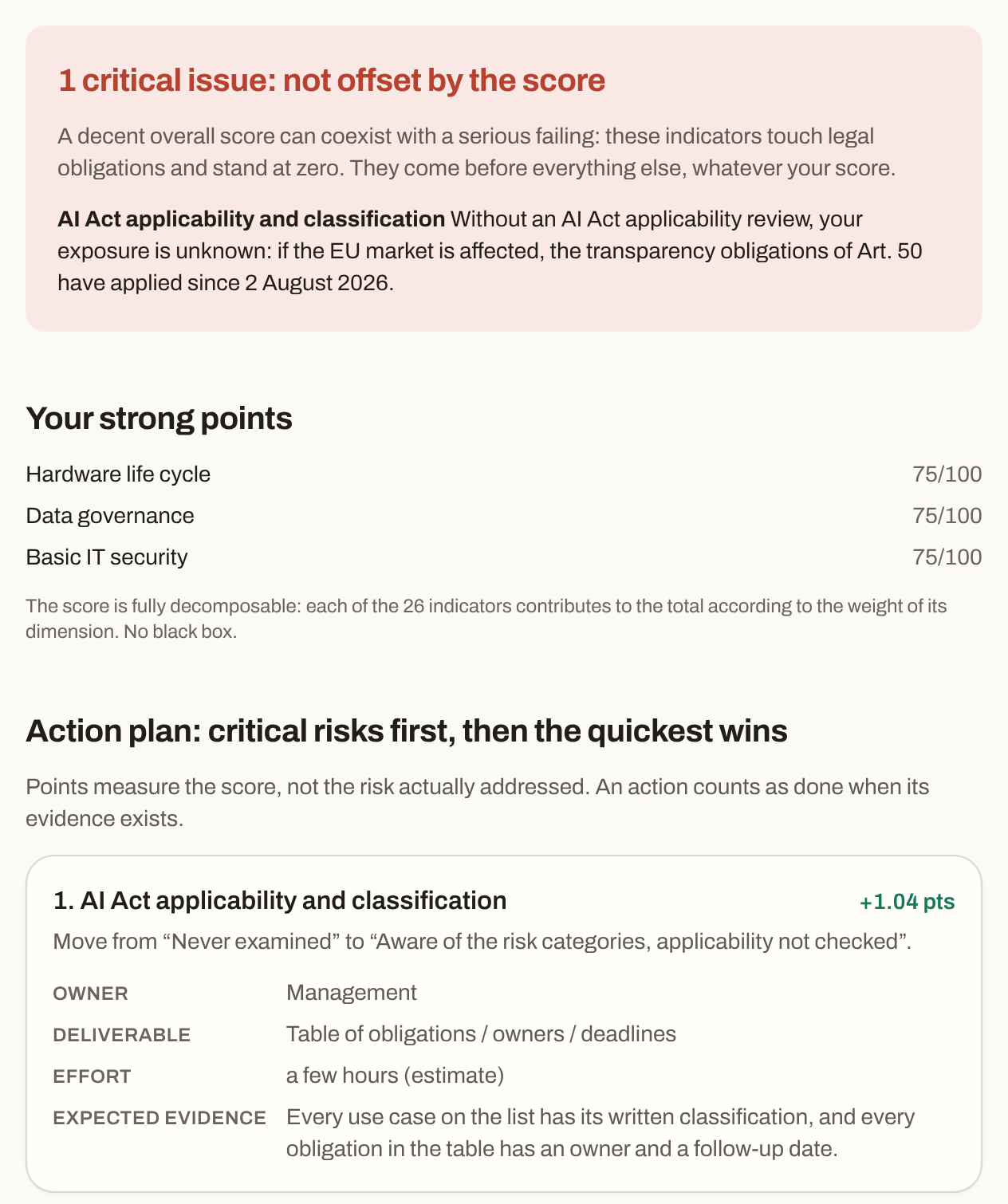
One critical point comes before everything else: AI Act applicability and classification.
- 03
The first action
AI Act applicability and classification
Owner: Management. Effort: a few hours. Outcome: Table of obligations / owners / deadlines.
| Use case | Classification | Deadline | Status |
|---|---|---|---|
| Customer service chatbot (website) | Transparency (Art. 50) | In force (2 August 2026) | Notice to be added |
| Application screening (HR module) | High risk (Annex III) | 2 December 2027 | To be governed |
| Internal writing assistance | Minimal risk | — | Compliant |
« You are chatting with an AI-based virtual assistant operated by Exemple SA. Replies are generated automatically and may contain errors. To speak with a person, type “advisor” at any time. »« Sie kommunizieren mit einem KI-basierten virtuellen Assistenten von Exemple SA. Die Antworten werden automatisch erstellt und können Fehler enthalten. Um mit einer Person zu sprechen, schreiben Sie jederzeit «Berater». »04The method
Four dimensions. One explainable score.
26 indicatorsTechnology and organisation
Safety, traceability and explainability of the digital and AI systems in use, and how an AI automation is set up and approved.
Compliance
Alignment with the FADP and, where your activities touch the EU, with the GDPR and the AI Act: records, data subject rights, impact assessments.
Environment
Footprint of digital infrastructure and usage, AI included: measured where the electricity is consumed, without offsets or purchased green electricity.
Society
Effects of your use of AI on people: accessibility, fairness, transparency, work and redress.
* weighting of our own profile (Digital & AI): the weighting adapts to your sector, justified profile by profile.
05The tools
Know what applies to you, and document it: three free tools
The documents an auditor, a large corporate client or an authority may ask you for. You fill them in within your browser, with no account.
AI Act classification
For each use case, 5 steps to find out whether the AI Act applies to your Swiss company, whether the use is a prohibited practice, high-risk or subject to a transparency obligation, and which obligations follow, with their deadlines.
FreeAI system register
The inventory of your AI systems, the starting point for the AI Act's obligations (Art. 26 and 50) and for an ISO 42001 approach (AI management systems), filled in automatically from your classifications. Exportable and printable.
FreeTransparency notices
Chatbots, generated content, deepfakes: your Art. 50 notices ready to paste, in French, German, Italian and English.
06Guided support
The flash audit: your situation assessed, together with you
Self-assessment is free. To go further, the flash audit covers, in 6 weeks: a guided diagnosis, a complete register, classification of all your use cases, presentation of the results to your management and a 90-day action plan.
Not ready for an audit yet? The expert debrief of your KarmaScore (60–90 min, CHF 690, deducted from the audit) is the first step. Groups and institutions from CHF 15’000: all prices.
SMEs · 10 to 249 employees
from CHF 4’900
The full flash audit, 90-day follow-up included: exact price fixed in writing at scoping, before any commitment.
Pilot cohort: the first 5 SMEs at CHF 3’900, in return for documented feedback, pilot cohort open.
07Leading by example
Our own assessment, before yours
We go through the same grid as you, with the same engine, and publish the result, weaknesses included. When a fact contradicts one of our answers, the level goes down and the page says so.
We sit our own exam
Our score, our 26 justified answers, our AI register and our dated commitments are public, and recalculated at every release.
Our own AI systems are declared and governed
Our two AI systems (report writing, website pre-analysis) are publicly inventoried, along with their safeguards. A report containing a figure that does not come from your data is rejected automatically. The model rewrites it once; if it fails again, you receive the standard report, written without AI.
Your answers stay in your browser
No account, no database, no advertising trackers. They only leave your device if you ask for an AI-written report, a website pre-analysis or a report by e-mail. Privacy policy updated on 26 September 2026: our e-mail service, the technical logs and the processing locations are now named.
Public, versioned methodology
Public formula, documented weightings, dated regulatory timeline, ISO 42001 mapping, and the limits of the α version stated in black and white. Our digital footprint is published together with its assumptions.
08Who runs the audits
The founder
A finance graduate specialising in finance and controlling, he works in risk management in the Swiss financial sector and is based in the canton of Vaud. He runs every scoping session, every debrief and every audit himself, with no subcontractor. And he applies to himself the grid he offers you: our score is public.
09FAQ
Frequently asked questions
Is it really free?
Yes: the assessment, the AI Act classification, the register and the transparency notices are free, with no account and no card. We sell the guided support (flash audit), not access to the tools.
Where do my answers go?
In your browser. They only leave it if you use one of three functions: the AI-written report, the website pre-analysis or sending the report by e-mail. We keep no copy of them, except the report you choose to send us; what our providers keep is described in the privacy policy. The cookieless audience measurement counts page views and a single click, and never sees your answers.
Is this legal advice?
No. AI-Karma provides dated, sourced reference information (FADP, GDPR, AI Act) to structure your work. Binding decisions go through your legal counsel: the tool saves them time, it does not replace them.
My company is 100% Swiss: does the AI Act concern me?
Possibly: it applies as soon as your customers or the output of your AI systems touch the EU. And Switzerland is preparing its own regulation (consultation on the draft bill planned for spring 2027). The classifier gives you the answer use case by use case, in 5 steps.
Who is behind AI-Karma?
An independent project from French-speaking Switzerland, run by its founder in the canton of Vaud. The best way to judge us: our own score is public, weaknesses included (/en/exemplarite)
Our company already has an EcoVadis rating. What is AI-Karma for?
EcoVadis rates a company’s sustainability management system against 21 criteria in four themes; none of them covers the company’s own use of AI (methodology V10.0, applicable since January 2026). AI-Karma assesses exactly that use: inventory of tools, data, human oversight, compliance, footprint and effects on people. Some questions touch on topics close to EcoVadis criteria, such as energy and greenhouse gases, responsible information management, discrimination or sustainable procurement. AI-Karma is not affiliated with EcoVadis, and nothing guarantees that an EcoVadis analyst will accept an AI-Karma result as supporting evidence.
26 questions to know where you stand.
If your customers are in the EU, the AI Act transparency obligation (Art. 50) has applied since 2 August 2026.
Get my KarmaScore